Hamas Disarmament Plan Encounters Major Hurdles But Offers Gaza Hope
Discover how a Hamas disarmament initiative faces significant challenges yet provides unprecedented opportunity for Gaza's future peace and reconstruction.
Hamas Disarmament Plan Encounters Significant Political and Military Obstacles
The proposed Hamas disarmament plan represents a pivotal moment in regional diplomacy, though the path forward remains fraught with complications stemming from decades of conflict, political mistrust, and the devastating humanitarian consequences witnessed throughout Gaza. Experts suggest that implementing such an ambitious initiative will require navigating complex geopolitical, military, and psychological barriers that have persistently undermined previous peace efforts in the region.
Political Realities and Historical Context
The political landscape surrounding any Hamas disarmament framework cannot be separated from the broader context of Israeli-Palestinian tensions and international involvement. Analysts emphasize that successful disarmament depends not merely on written agreements but on fundamental shifts in how competing parties perceive security and coexistence. The historical pattern of failed negotiations demonstrates how political calculations often take precedence over humanitarian considerations, making even preliminary discussions extraordinarily challenging.
Political leaders from multiple factions must simultaneously address domestic constituencies expecting concrete gains while pursuing compromise solutions that inherently require concessions. This delicate balancing act has repeatedly paralyzed previous negotiation attempts, leaving populations in Gaza caught between competing political interests and security concerns.
Military Challenges and Verification Complications
Beyond political negotiations, the military dimension of any disarmament initiative presents extraordinary logistical and verification difficulties. Weapons caches distributed throughout Gaza's dense urban areas create immense challenges for international monitors and verification teams. The underground tunnel networks, fortified positions, and dispersed arsenals accumulated over decades require systematic identification, documentation, and secure removal—processes that demand unprecedented cooperation and transparent commitment from all parties involved.
Military experts note that Hamas disarmament must address not only conventional weapons but also sophisticated rocket systems, explosive devices, and military infrastructure integrated into civilian areas. This complexity multiplies verification challenges exponentially and requires innovative monitoring mechanisms that respect legitimate security concerns while preventing weaponized deception.
Trust Deficits and Psychological Barriers
Perhaps the most formidable obstacle involves the profound lack of mutual trust accumulated through generations of violence and betrayal. Both Israeli and Palestinian populations harbor deep-seated security anxieties rooted in legitimate historical grievances and recent trauma. A meaningful Hamas disarmament plan must address these psychological barriers by establishing credible mechanisms that provide genuine security assurances to all communities affected by conflict.
Zero trust environments, where parties assume the worst of potential adversaries, dominate current thinking. Breaking these patterns requires demonstrable commitments, transparent verification processes, and confidence-building measures that progress gradually through proven reliability rather than optimistic declarations.
Humanitarian Devastation and Reconstruction Imperatives
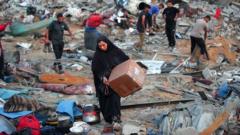
The massive destruction throughout Gaza creates urgently necessary preconditions for any successful disarmament framework. Thousands of casualties, displaced populations, destroyed infrastructure, and collapsed institutions generate humanitarian imperatives that could paradoxically facilitate diplomatic progress. When populations face desperate conditions requiring reconstruction, they sometimes recognize that ongoing militarization prevents essential economic and social recovery.
However, this same devastation also complicates disarmament by creating power vacuums, displaced armed factions, and populations seeking revenge or protection—circumstances historically fertile for renewed conflict. Successfully transforming humanitarian desperation into constructive momentum requires careful international engagement, substantial reconstruction investment, and mechanisms addressing accountability for previous violations.
International Involvement and Diplomatic Architecture
The Hamas disarmament plan necessarily involves multiple international stakeholders, regional powers, and multilateral institutions. Coordinating these diverse actors around unified objectives presents coordination challenges nearly equivalent to the disarmament process itself. Different nations bring competing interests, strategic priorities, and diplomatic relationships that inevitably complicate consensus-building.
Limited Yet Meaningful Hope for Regional Stability
Despite these formidable obstacles, experts argue that acknowledging disarmament possibilities represents genuine progress. Previous decades witnessed complete diplomatic rejection of such conversations; their current inclusion in serious policy discussions signals evolved thinking about conflict resolution. The emergence of concrete proposals, however complicated their implementation may prove, demonstrates recognition that military approaches alone cannot resolve underlying political disputes.
The rare hope emerging from these difficult discussions stems not from naive optimism about immediate success but from acceptance that alternatives—perpetual conflict, recurring humanitarian catastrophe, and blocked development—demand serious consideration of alternative pathways. A Hamas disarmament framework, if successfully implemented through sustained international cooperation, patient diplomacy, and genuine commitment from regional stakeholders, could unlock possibilities for Gaza's long-suffering population.


